
Mohanad Smama
he/him
Dancer and choreographer
Country: France – Palestine
Discipline: Dance
Type of public space: All types

PLATFORM 2025 - 2028 2027 creations


Artist's pitch
Biography
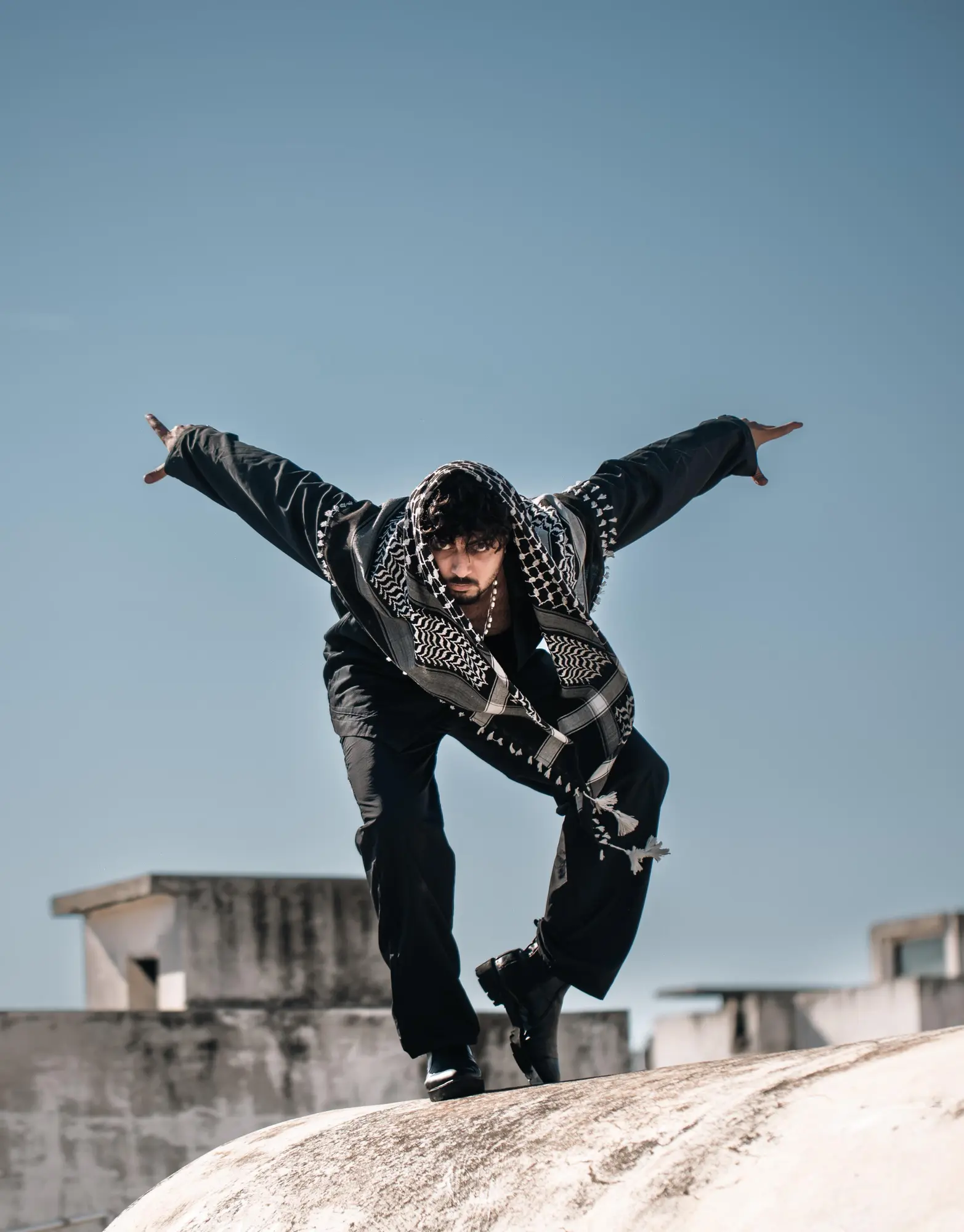
Mohanad Smama is a Palestinian contemporary dancer, choreographer, and videographer from Gaza. Graduated from the Faculty of Physical Education, he is recognized as one of the pioneers of contemporary dance in his city. He is the founder of Hai Team for contemporary arts , the first studio and company dedicated to contemporary dance in Gaza. There, he developed a unique movement methodology that merges traditional Palestinian Dabke with contemporary dance, while integrating social issues, personal narratives, and his daily experience under blockade before his arrival in France at the end of 2024. He also managed several cultural and artistic programs, as well as a dance festival in Gaza in cooperation with various Palestinian institutions.
His work reimagines the Palestinian body as a living archive of memory, resistance, and creativity. Over the past decade, Mohanad has trained hundreds of young artists, created numerous award-winning choreographic works, and produced innovative dance films.
After surviving six months of genocide in Gaza, he is now continuing his artistic practice in exile, based in Marseille, where he teaches, performs, and develops multidisciplinary projects combining dance, cinema, and creative technologies.
Mohanad is a recipient of the PAUSE program of the Collège de France and is currently in a two-year residency supported by Les Rencontres à l’échelle / Bancs Publics, Shonen Company, the Ballet National de Marseille, and La Friche la Belle de Mai.
He is currently developing the choreographic solo Limitless, the lecture-performance Moment, and the participatory project Dabke Alive, all of which explore the relationship between memory, displacement, and the living heritage of Palestinian movement.
Artistic project
LIMITLESS - بلا حدود is a solo dance performance by Palestinian artist and choreographer Mohanad Smama. The work explores the relationship between the body, memory, identity, and place, and the traces, experiences, and stories that our bodies continue to carry even after leaving the places where we grew up. The first stages of reflection, writing, and artistic research for this work began while Mohanad was still in Gaza during the genocide. During this period, he began collecting sounds, images, scenes, and memories, reflecting on how the body responds to events and changes taking place in its surroundings. At the same time, Palestinian Dabke remained present even in the most difficult circumstances, as a collective practice and an attempt to create moments of joy, connection, and life. After leaving Gaza, Mohanad continued developing the project during his time in Egypt and later in France, through writing, choreographic research, and physical experimentation. As the work evolved, a renewed relationship began to take shape between the body's memory and its experience in the present, between the movements it carries from the past and the new experiences and relationships formed throughout this journey. By bringing together Palestinian Dabke and contemporary dance, I am developing movement in which Dabke becomes a living archive of individual and collective memory. It appears not only as cultural heritage, but also as a contemporary physical language carrying meanings of joy, belonging, and connection, alongside loss, absence, resilience, and transformation. LIMITLESS unfolds as an intimate dialogue between the body and its memory. The work raises questions about our relationship with the places to which we belong: What does the body carry from the place where it was born? How do places, people, and sounds continue to influence our movements? And how can a simple gesture, a sound, an encounter with someone, or the experience of being in a particular place bring a memory or sensation from the past back into the present? The body becomes a living archive, carrying places, experiences, and histories beyond geographical borders. Although the work is rooted in a personal experience connected to Gaza, it opens up a broader space for reflection on how we rebuild our relationship with identity, memory, and belonging, and how our past experiences continue to shape our present and our relationships with others. LIMITLESS is being developed through two interconnected artistic versions: an indoor version designed for theatres and an outdoor version intended for public spaces. Both versions emerge from the same artistic research, but each develops its own language and a different relationship with space and the audience. In the outdoor version, public space is not simply a location for presenting the performance, but becomes an essential element of its choreographic and dramaturgical composition. The work explores the relationship between the body, distances, boundaries, and transitions from one place to another, where the audience's movement through space becomes part of the artistic experience. The relationship between the performer and the audience goes beyond traditional spectatorship through individual and collective encounters, shared movements, and physical responses that may be spontaneous or intentional. These relationships develop through proximity and distance, waiting and crossing, emotions depending on the momentary situation, individual movement, and collective energy. Palestinian Dabke plays a central role in these transformations, becoming a means of encounter, connection, and the creation of shared memory between the performer and participants. Through transitions between Dabke and contemporary dance, the work explores how the same movement can carry different meanings. The project continues to evolve through ongoing artistic research and experimentation in different spaces, focusing on the relationship between the body, the audience, music, sound, and scenographic elements, and on how the experience changes according to the nature of each location and the people involved. Beyond the performance, the project extends through workshops with young people and local communities, using Palestinian Dabke and contemporary dance as tools for expression, connection, and the sharing of memory embodied in the body. Technical and Artistic Information Format: Solo dance performance, being developed in two versions: indoor and outdoor. Audience Capacity: Adaptable according to the venue and the nature of the performance. Suitable Locations: The outdoor version of LIMITLESS can be presented in a variety of urban, industrial, and natural environments, such as streets, alleyways, and passages between old or abandoned buildings, open and semi-enclosed squares, warehouses, industrial workshops, and unfinished buildings, as well as spaces surrounded by natural landscapes and trees.
Format: solo performance / adaptable for indoor and outdoor spaces
Size of audience: adaptable according to the venue
Specific location: different spaces, in the street between buildings, in an open area close to the environment from which the idea originally emerged, the city of Gaza, or in nature among trees, or on the seashore.
Timing/duration: 56 minutes


Related content
PLATFORM 2025-2028
Boosting emerging artists' international careers
Open call #2
PLATFORM 2025-2028